That’s the Mantra I’m feeling today… SLAY That Dragon!
Transcript: Methadone System and Human Cost
Speaker 0:
(Plz note: This is a direct transcript from an interview- so I’m asking for leniency regarding piss-poor spelling, grammar, and repetitive pauses “um…”
I found it kind of disturbing when I’ve noticed that the people I’ve met that are involved in doing a lot of meth or cocaine or end up becoming heroin addicts seems to be a common theme of good versus evil, and they’re always on the wrong side of that equation.
The reason it comes up is like many of the people I’ve spoken with or interviewed, they talk about demons, and, uh, I’ve actually watched, uh, personality shifts, literally, in some cases, anywhere from three to six different personalities. Um, I talked with one girl that would be very, very normal until she got high, and even then she was okay.
But when she got really, high, uh, she would turn into, uh, the pipefitter. And this is like almost a masculine version of herself, and she wouldn’t get away from it. Uh, she would constantly talk about being a macho pipefitter and using that as a way to externalize, um, inner aggression that was she, she was expressing. And I think it was, uh, my interpretation of it was that this is her way of coping with, um, men.
Men that she had been either because of economic circumstances or whatever, uh, been forced in her own mind or for money reasons, um, to be intimate with or to engage in any kind of, uh, reciprocal, you know, uh, sexual arrangement that, uh, I think inherently she felt was degrading and, um, hateful. Uh, clearly there was a lot of hate there. Uh, I spoke with another, uh, lady that basically had given up hope. Um, she said that she was finally in a spot where she didn’t know what to do, and that was repeated many times during the conversation. And, uh, it was, sad. And what’s interesting is that she was, uh, tried to shoot up some, uh, some meth, but, um, she came from a history of being a, a heroin addict, and it switched to, uh, methadone. And the way that methadone works is it either puts her to sleep or accelerates her behavior depending on what her mindset is or her circumstances.
Now, what was really disturbing about this as well is that she would need to get a dose of methadone every single day. So she would go to the methadone clinic, and the methadone clinic would supply drivers that would drive her basically an hour and a half one direction to come get her dose and then drive her back. And the drivers and obviously the, um, dosing facility are all, you know, subsidized by government grants. Um, they have their own source of income. So it seems like it’s an entire system that revolves around, um, the end product that is a living, walking zombie, um, a heroin addict that is now a, a very serious, uh, methadone addict, even though methadone is not a, uh. Well, it is a controlled substance, but it’s not an opiate-based, uh, substance. So therefore, I guess it’s, it’s deemed, uh, acceptable, um, to keep these people using methadone so they don’t go into any sort of, uh, um, rejection or, you know, withdrawal period.
Now, this girl, she was severely interested in how well she was severely afraid of going to withdrawal, and she changed her addiction to heroin for this oddly similar other addiction to methadone, where when she gets to the clinic, uh, they test her every once in a while. And if she does not pass that test, in other words, if she tests positive for marijuana or meth or any other substance that she’s used, then she cannot get a dosing amount, uh, for the entire month, which is one per day. But she has to come back every single day to get her daily dose.
And this basically becomes a daily nightmare for her because she has to make arrangements with these drivers who themselves are almost like jailers to a degree. In other words, very passive-aggressive in their approach in how they deal with, uh, meth addicts because they realize that these, um, methadone addicts need the- their dro– their ride so that they can get their dose. So that gives them a certain amount of power over, uh, the people that are basically paying her, their bills.
In other words, the drivers really work for the addict that they’re driving because ultimately some funding agency is going to bill money, either it comes from the state or the US government, uh, for that particular person’s ride on that particular day that then goes to the driver. So- Instead of being at the, uh, whim of prison guards who tend to abuse, uh, their newfound power over other people, they themselves become victims to drivers and, uh, whether or not these drivers are decent people or they just prey upon, uh, people in a compromised position, they can’t fight back.
I find this, uh, I find this abhorrent and it makes, it very obvious that there are a lot of people in our world or in this particular environment that even though themselves, they themselves have not ever been, you know, caught or, you know, had any legal issue, they somehow escape the long arms of the law or whatever it is, live a pristine life, um, they end up becoming complete and total assholes when it comes to, uh, any ounce of humanity shown to the people that, uh, they’re, they’re ostensibly there to give a ride to and back, uh, to get their medication.
It’s probably no, no different than people that abuse the elderly and, and, uh, you know, old, old folks homes and that kind of thing because give a, um, person an ounce of power that hasn’t earned it by either academic, uh, achievement or hard work. These are probably, you know, the, uh, not the top, they’re not the cream at the top, but they’re bottom dwellers that just haven’t actually found their way into a jail yet.
So these people, um, in my opinion, um, are damned to go to hell, but instead they, uh, they thrive on other people that are victims of their own, um, mistakes and that are expected to earn some sort of reprieve from their mistakes. In other words, they have to work off their punishment. So to me, this seems like a never-ending cycle. It’s hard to break. And I’m sure there are a lot of people that get, flushed down the toilet, eventually just die of addiction, um, that aren’t really on the, books, you know, on the books.
You know, these aren’t people that you read about in the paper. Like usually when somebody dies, you know about it, you know why. These people, they die or they go away or disappear, whatever it is they do. And nobody gives a shit or bothers to ask the question because they’re not really newsworthy or media worthy and they’re not deemed as human beings anymore because they’re in this, uh, drug cycle.
So I feel that we as a society, and there’s an old adage that society is always judged by how it jails its own population.
We’re a very cruel society and we do not give a damn about rehabilitation for people that use drugs. And we have a label. And honestly, I think people that use drugs are probably right up there lower than people that have domestic violence issues that slap the shit out of their, you know, uh, spouses, uh, people that abuse their kids. You got the drug addict that somehow the only person they really hurt is themselves, but they’re deemed less worthy of respect and life and hope than some of these assholes that should be in jail for a long, long time that decide because they’re having a bad day, they can beat, they’re having a bad day. They can go ahead and beat the shit out of whoever it is that they’re around and do it with almost no ramifications. I think the way we approach this is disgusting and I’m ashamed to, uh, be a part of a society that would treat its people like this.
__________________

Summary: Methadone System and Human Cost
Lets Inject (no pun) AI into the equation and do a comparison:
Core Thesis
The current systemic approach to drug rehabilitation—specifically the methadone clinic model—functions as an “invisible prison” that replaces one addiction with another while stripping participants of their agency. This cycle is perpetuated by a subsidized infrastructure that empowers low-level administrative actors (such as transport drivers) to exert disproportionate control over vulnerable individuals, effectively dehumanizing them.
The Methadone Industrial Complex
The transition from heroin or methamphetamine to methadone is framed not as recovery, but as a
lateral shift into a government-subsidized dependency.
* The Daily Nightmare:
Patients are often required to travel significant distances daily to receive a single dose. Failure to pass a drug test results in the loss of “take-home” privileges for a month, forcing a return to the daily travel cycle.
*Subsidized Control:
The system is funded by government grants that pay for dosing facilities and
specialized transport. This creates a self-sustaining economy centered on the “living zombie”—the long-term addict.
* The Power Gap:
Drivers and clinic staff, described as “bottom dwellers” who
have not earned authority through merit, often adopt a passive-aggressive or abusive stance. They act as “jailers” because they control the addict’s access to the medication required to avoid
withdrawal.
Psychological Observations: Addiction and Identity
Addiction is observed as an accelerator of personality shifts and a mechanism for externalizing
trauma.
* Personality Fragmentation:
High-intensity drug use (meth/cocaine) frequently results in
distinct personality shifts. One case study involved a woman who adopted a masculine persona, “the pipefitter” to cope with a history of sexual degradation and aggression toward men.
* The Good vs. Evil Equation:
There is a recurring theme of spiritual or moral conflict in those involved with heavy
drug use, with many users describing their experiences in terms of “demons” or being on the “wrong side” of a moral divide.
Societal Critique: The Hierarchy of Worth
Society is judged by how it treats its most vulnerable, and the current “drug cycle” is deemed a
failure of humanity.
* Devaluation of Life:
Drug addicts are often viewed as less worthy of respect than individuals who commit violent acts (e.g., domestic abusers). Because their harm is perceived as self-inflicted, they are “flushed down the toilet” of the social record, their deaths or disappearances going unremarked by media or the public.
* The Failure of Rehabilitation:
The existing framework prioritizes punishment and “working off” one’s mistakes over genuine restoration, leading to a “dysphoric” and “cruel” social environment.
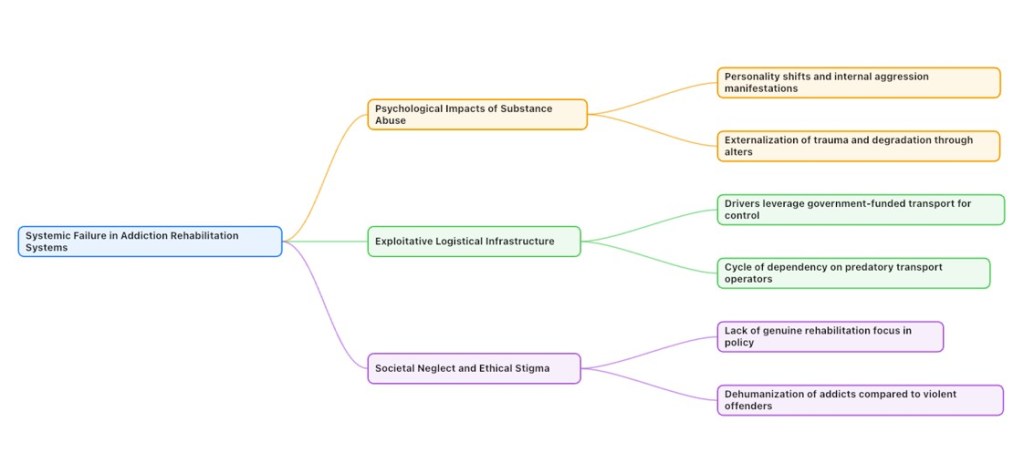
Addiction -> Methadone Clinic Enrollment Methadone Clinic Enrollment -> Government Subsidized Transport Government Subsidized Transport -> Power Imbalance (Driver vs. Patient) Power Imbalance (Driver vs. Patient) -> Daily Travel Requirement Daily Travel Requirement -> Sustained Dependency Sustained Dependency -> Addiction


Share your thoughts?